
"Most of my ticket queue is position-related. Stale positions never closed, duplicates from managers who didn't know one existed, security tied to positions that shouldn't exist anymore. It's a full-time job."
— r/workday
Roughly 80% of Workday customers turn on Position Management because they need real control over headcount. The intent is right. But across hundreds of public threads from HRIS, Finance, and Recruiting teams, the story is the same.
Workday tells you a position exists. It can't tell you whether that role is actually approved, funded, and safe to hire, with everyone agreeing. That gap is where the cleanup, the mismatched numbers, and the spreadsheets live.
Every quote below is from a real Workday customer on a public operator forum. The pattern is identical across industries, company sizes, and Workday tenure.
"Most of my ticket queue is position-related. Stale positions never closed, duplicates from managers who didn't know one existed, security tied to positions that shouldn't exist anymore. It's a full-time job."
"FP&A maintains the headcount plan in Adaptive. Workday holds the positions. They never match. Reconciliation is a monthly project that consumes a full analyst's time."
"Headcount cost variance hits the P&L six months after the decisions that caused it. The control should have been at the approval, not the reconciliation."
"Workday positions don't tell me if I should actually open this req. The position is technically there, but I can't tell if Finance has authorized it or if it's still pending budget review."
"I'm a manager. Why is opening a role so complicated? I have approved headcount in my budget. I just want to post the job. Why do I need to understand the difference between a position and a requisition?"
Workday is excellent at what it was built for: the durable record of who works here and what positions exist. That should stay in Workday.
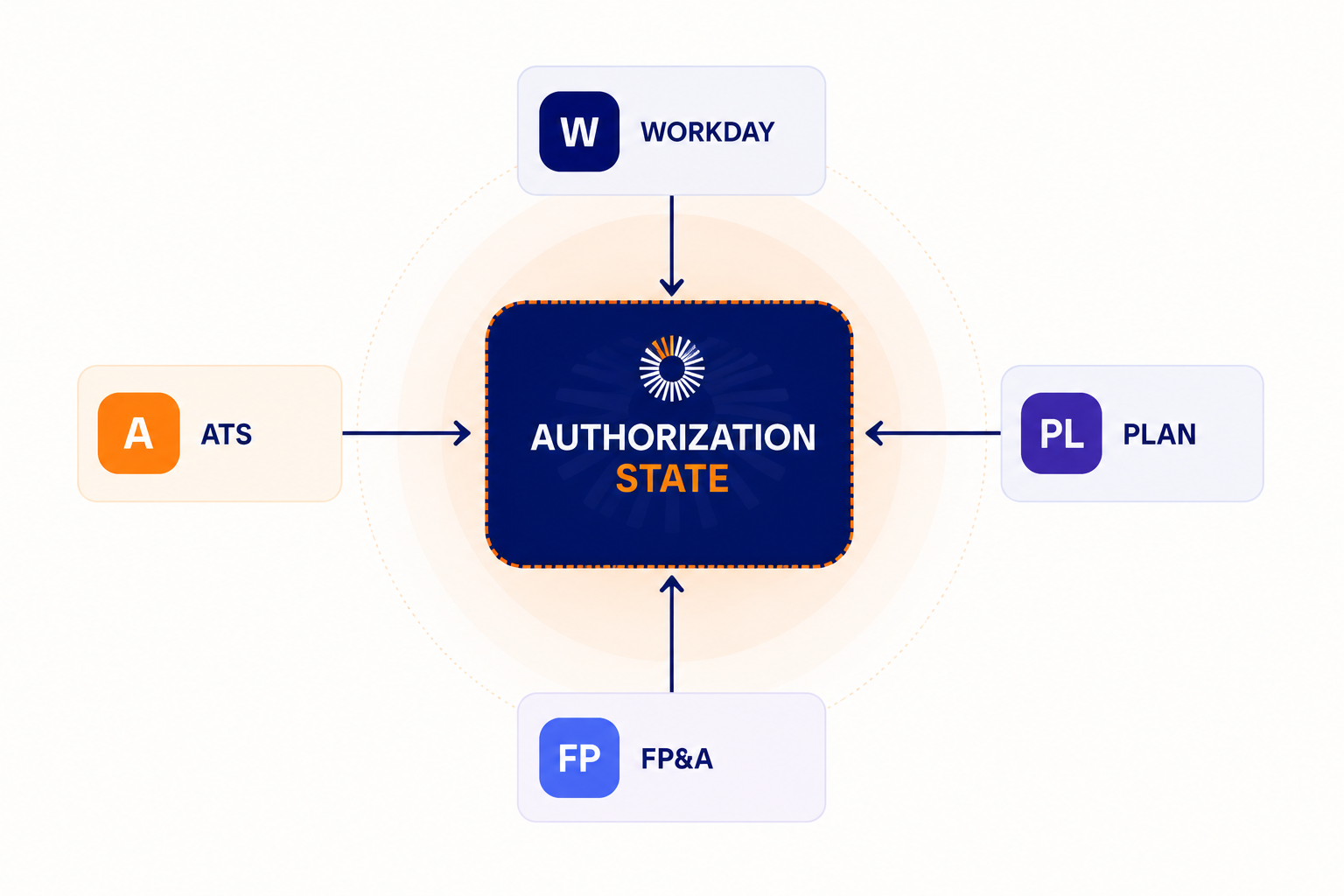
But "is this role approved to hire, funded, and agreed on by everyone?" is a different question, and the answer has to line up across four places at once: Workday, your recruiting system, your finance plan, and your budget. Workday was never built to keep all four in sync.
So teams patch it themselves. HRIS lives in cleanup mode. Finance builds its own tracker. Recruiting opens a role and learns three weeks later it got frozen. The same position means one thing to Finance, another to HR, another to Recruiting, and nobody can reconcile them.
The fix isn't more Workday configuration. It's one shared layer above Workday that keeps everyone on the same number.
One place that shows whether a role is approved, funded, and safe to hire, shared across Workday, your recruiting system, your finance plan, and your managers. Live, role-based, and audit-ready.
A clean state machine — planned → authorized → open to recruit → frozen → filled — that lives above Workday. Bad state can't enter the system. Stale positions, duplicate backfills, and frozen roles still recruiting all get caught before they become a ticket.
HRIS stops being the cleanup crew.
Every position request is checked against the active plan in real time. Approvers see budget impact at the moment of the decision, not six months later at the variance review. Comp band drift inside open reqs surfaces immediately.
Catch the overspend at approval, not six months later.
Workday holds the position. The ATS holds the req. FP&A holds the plan. TeamOhana holds the cross-system meaning that says they all agree. When the CEO asks "how many approved but unfilled roles do we have?" there is one answer, not three.
One number everyone trusts.
The clearest way to understand TeamOhana is to see what we deliberately don't own. Workday is the HRIS. We don't touch payroll, time, benefits, or worker master data. We live above the system of record, not inside it.
"Workday remains your system of record for employees and positions. TeamOhana sits above Workday and owns the authorization state, the cross-system meaning that Position Management alone cannot enforce."
Monthly Finance vs HR headcount reconciliation projects
HRIS queue dominated by stale, duplicate, and orphaned positions
Headcount cost variance discovered six months late
Two-day reconciliation drills before every board meeting
No. We coexist with Workday by design. Workday stays your system of record for workers and positions. We add the authorization layer above it. Most customers go live in 6 weeks without changing a single Workday configuration.
Workday's BP framework is powerful but it lives inside one system. The authorization problem is cross-system: it spans Workday, your ATS, your FP&A tool, and your plan. No matter how richly you configure Workday BPs, they can't enforce meaning in systems Workday doesn't own. That's a structural limit, not a configuration gap.
No. TeamOhana is a layer, not another tenant to administer. There are no business processes to author, no security roles to migrate, no integrations to hand-build. We connect to Workday, your ATS, and your FP&A tool through pre-built integrations in 6 to 8 weeks. Across our customer base, HRIS time on TeamOhana after go-live averages under 2 hours per week, and that's mostly people asking questions, not configuration work.
If any of those quotes sounded like your team, the gap is already costing you in cleanup hours, late surprises in the budget, and time spent reconciling numbers that should already agree. The question is how much.
A self-serve scorecard that surfaces the specific failure patterns showing up in your environment, scored against the nine documented operator failure modes. You get the result. No demo required.
Start the health checkA live walkthrough of TeamOhana running above a real Workday tenant, with your CFO, Head of Talent, and HRIS lead in the room.
Schedule time with an expertWorkforce decisions. Finally authorized.